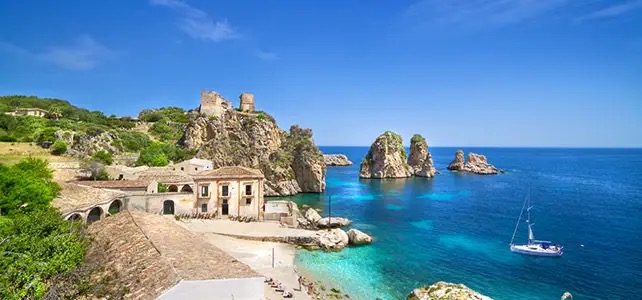
Sicily is the largest and most populous island in the Mediterranean Sea and one of Italy’s 20 administrative regions.
Known for its unique cultural identity, it has been a crossroads for diverse civilizations including Greeks, Romans, Arabs, and Normans leaving behind a rich tapestry of history, art, and architecture.


- Palermo: The vibrant capital known for its “gritty charm,” historic street food markets, and the 12th-century Monreale Cathedral, which features stunning mosaics and breathtaking architecture. Visitors can explore the lively neighborhoods brimming with culture, art, and various culinary delights that showcase the city’s rich history and heritage.
- Catania: A major port city on the eastern coast of Sicily, serving as a gateway Mount Etna, Europe’s highest active volcano, known for its rich history, vibrant markets, stunning Baroque architecture, and proximity to beautiful Mediterranean beaches.
- Taormina: A popular hilltop resort town renowned for its breathtaking stunning views of the sparkling Ionian Sea, charming narrow streets filled with quaint shops, delightful restaurants serving exquisite Sicilian cuisine, and an ancient Greek theater that attracts visitors with its well-preserved architecture and rich history.
- Syracuse (Siracusa): Famous for its ancient Greek ruins and the historic island center of Ortygia, which boasts stunning Baroque architecture, vibrant local markets, and a rich cultural heritage that attracts history enthusiasts and tourists alike.
- Agrigento: Home to the Valley of the Temples, a UNESCO World Heritage site featuring some of the best-preserved ancient Greek temples in the world, surrounded by stunning landscapes and rich history, making it a must-visit destination for those interested in ancient civilizations and archaeological wonders.
- Food: Sicilian cuisine is world-renowned for its fresh seafood, arancini (rice balls), cannoli, and pasta dishes heavily influenced by the island’s multicultural past. The vibrant use of local ingredients, such as sun-ripened tomatoes, capers, and olives, enhances every dish, creating a symphony of flavors that reflects both the land and the sea. Traditional meals often include a variety of antipasti, showcasing the region’s rich agricultural heritage and highlighting its commitment to quality, seasonal produce.


Sicilia still run by the Mafia 2025-2026:
The Sicilian Mafia, or Cosa Nostra, remains an active, resilient criminal force in Sicily today, though it has evolved from visible violence to discreet, economic-focused crime.
While law enforcement has severely weakened its top leadership, the mafia has adapted by using encrypted technology for communication, diversifying into drug trafficking, online gambling, money laundering, and infiltrating legitimate businesses.
- “Invisible” Mafia: Unlike the violent era of the early 1990s, the modern mafia rarely uses high-profile killings, preferring to operate in the shadows to avoid government attention.
- Economic Infiltration: The mafia heavily invests in legal businesses, particularly in construction, agriculture, and online betting, and often forces local restaurants to use their products.
- Enduring Extortion: Protection racketeering (pizzo) still exists, with some reports suggesting a significant percentage of businesses still pay tribute to local clans, though often more discreetly.
- Echnological Shift: New generation bosses use encrypted smartphones to manage operations, making surveillance harder for authorities.
- Regeneration: Despite major raids, such as the February 2025 arrests of over 180 people in Palermo, the organization continues to attract young members and maintains a strong, traditional, and familial structure.
Area of operations:
- Palermo & Catania: These remain the main hubs, with the Santapaola-Ercolano clan being particularly influential in Catania.
- Collaborations: The Sicilian Mafia has deepened ties with mainland Italy’s ‘Ndrangheta, which is heavily involved in cocaine trafficking.
- The “Stidda”: A separate criminal group in southern Sicily (the Stidari) has grown in power, often collaborating with Cosa Nostra.
While the immediate risk of violence for residents and tourists is much lower than in the past, the Mafia’s economic stranglehold, particularly through extortion and money laundering, remains a critical problem for local economic development.
911 vs call The mafia:
Leave a Reply